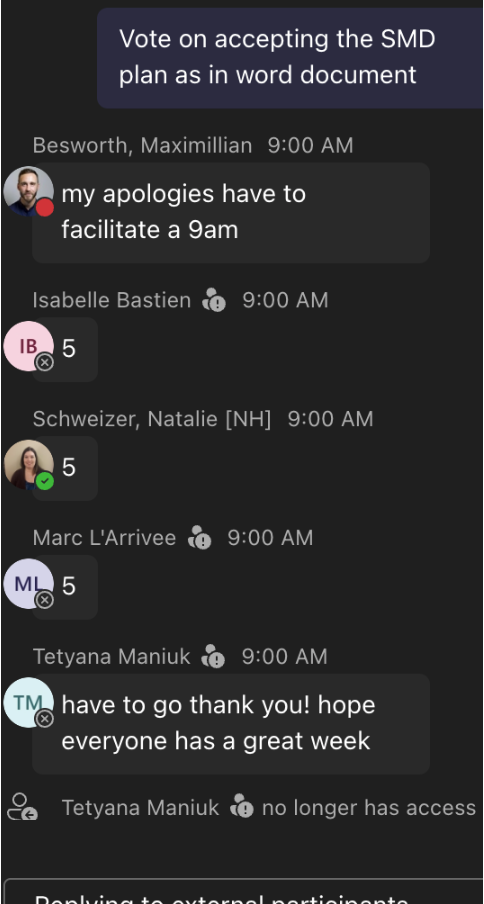
June 1, 2026
I) Review Decision regarding the document used to discharge a patient from a hospital i.e. ToS = Discharge
Remove 'Note'
Exclude Hospital from Setting
General support for removing Note and excluding Hospital from Setting field.
Action: Marc to investigate Manitoba use of "ED Discharge Note" when they admit someone to hospital. Question:can they write a "transfer note"? Or an "ED Consult Note" and the system recognizes it as an equivalent to a discharge note? Action completion: In Manitoba emergency department, they do a consult by filling out a template document and then do an ED discharge by clicking a button, and it adds the word “Discharge” to the title.
Note: Choosing Admission and Discharge documents to be only for admission and discharges from whole facilities, not units ensures that the document type will include what is expected by the reader (a summary of a whole hospital stay or whole evaluation before admission), no semantic overlap with the patient going in and out of a ward. It also allows for markers of hospital encounters when there isn't other encounter information.
Concept Creation Guide for ToS = Discharge
| Preferred | Allowable | Roll Up Term | Summary | |
|---|---|---|---|---|
| Kind of Document | Note | Note | Note | Note |
| Type of Service | Discharge Summary | Discharge Summary | Discharge Summary | Discharge Summary |
| Subject Matter Domain | Suppressed | Any | Suppressed | May |
| Role | Suppressed | Suppressed | Suppressed | Never |
| Setting | Suppressed | Any facility that requires an admission and discharge. Excluding Hospitals and units within the hospital, such as: ICU, Emergency Dept, Observation unit, Pharmacy, Recovery Room | Suppressed | May - if needed for regulation or accreditation of the facility. |
| LOINC | 18842-5 | Many | 18842-5 | 18842-5 |
| Display Guideline | Remove 'Note' | Remove 'Note' | Remove 'Note' | Remove 'Note' |
| Note | By definition of Discharge, the setting is a hospital | Only use SMD if one discipline/SMD cared for the patient during the hospitalization, but this is not required. |
II) Review decision regarding documenting a consultation being requested ie. ToS = Consultation
a) Remove 'Note'
b) Exclude Medical Students, Attending, Physician, Fellow etc.... from Role
Concept Creation Guide for ToS = Consultation
| Preferred | Preferred | Allowable | Roll Up Term | Summary | |
|---|---|---|---|---|---|
| Kind of Document | Note | Note | Note | Note | Note |
| Type of Service | Consultation Note | Consultation Note | Consultation Note | Consultation Note | Consultation Note |
| Subject Matter Domain | Any | Any | Any | Suppressed | Must |
| Role | Suppressed | Restricted to Any except physician roles such as Medical Student, Attending, Physician, Fellow, Resident | Restricted to Any except physician roles such as Medical Student, Attending, Physician, Fellow, Resident | Suppressed | May - if non-physician |
| Setting | Suppressed | Suppressed | Any | Suppressed | May- if necessary |
| LOINC | May available | Some | Some | 11488-4 | |
| Display Guideline | Remove 'Note' from name | Remove 'Note' from name | Remove 'Note' from name | Remove 'Note' from name | Remove 'Note' from name |
| Note | Role of physician is most likely so not specified | This option is for authors like NPs or PA's | Specifying the setting does not change the expected content of the document. Therefore, it is not supported by ontology principles |
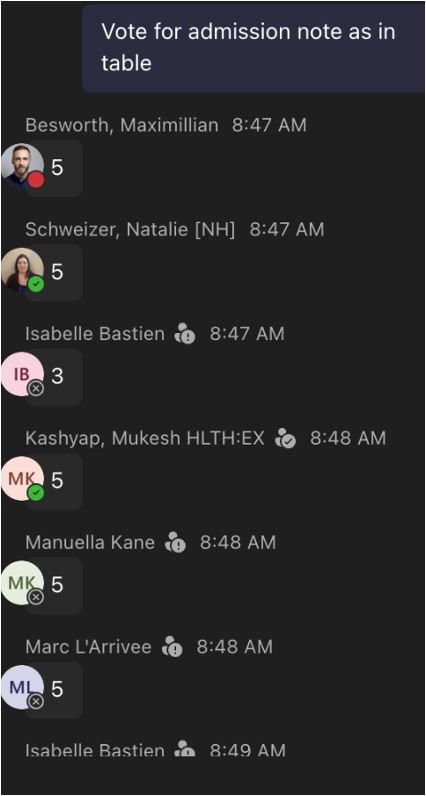
III) Review documentation of an Admission to hospital i.e. ToS = Admission for inclusion in Ontology
a) Specify all SMD
b) Do not specify Setting = Hospital or parts of hospital
Note that patients can be admitted directly to the ICU or to the neonatal intensive care unit. In this case, the document is classified by the training of the author, so this would be a Critical care medicine or Neonatal medicine document. Action: Check the difference between Neonatal and Perinatal with Isabelle.
In the case of needing to escalate care of someone who's already admitted we often say "Admission to ICU", and the ICU team writes an Admission note. We would prefer admission notes to be specific to admission to a hospital. The committee felt that it was reasonable to ask hospitals to change their workflow, calling an escalation of care to the ICU a Critical Care transfer note. This strict use of the Admission document type, ensures semantic clarity with no overlap.
c) Do not specify Role
Concept Creation Guide for ToS = Admission Evaluation
| Preferred | Allowable | Roll Up Term | Summary | |
|---|---|---|---|---|
| Kind of Document | Note | Note | Note | Note |
| Type of Service | Admission Evaluation | Admission Evaluation | Admission Evaluation | Admission Evaluation |
| Subject Matter Domain | Any | Any | Suppressed | Must |
| Role | Suppressed | Restricted to Any except physician roles such as Medical Student, Attending, Physician, Fellow, Resident | Suppressed | May - if non-physician |
| Setting | Suppressed | Any facility that requires an admission and discharge. Excluding Hospitals and units within the hospital, such as: ICU, Emergency Dept, Observation unit, Pharmacy, Recovery Room | Suppressed | May - if needed for regulation or accreditation of the facility. |
| LOINC | Many | Many | 11488-4 | |
| Display Guideline | Remove 'Evaluation Note' | Remove 'Evaluation Note' | Remove 'Evaluation Note' | Remove 'Evaluation Note' |
| Note | By definition of Admission, the setting is a hospital | Only use SMD if one discipline/SMD cared for the patient during the hospitalization, but this is not required. |
IV) Review SMD for inclusion in Ontology
a ) List of modified LOINC SMD display names
b) Divided names
c) Generalized RCPS names
d) Semantic Overlap for two names
e) Requested RCPSC names
f) CFPC specialties